
What Documents Are Required for Power of Attorney in Saudi Arabia
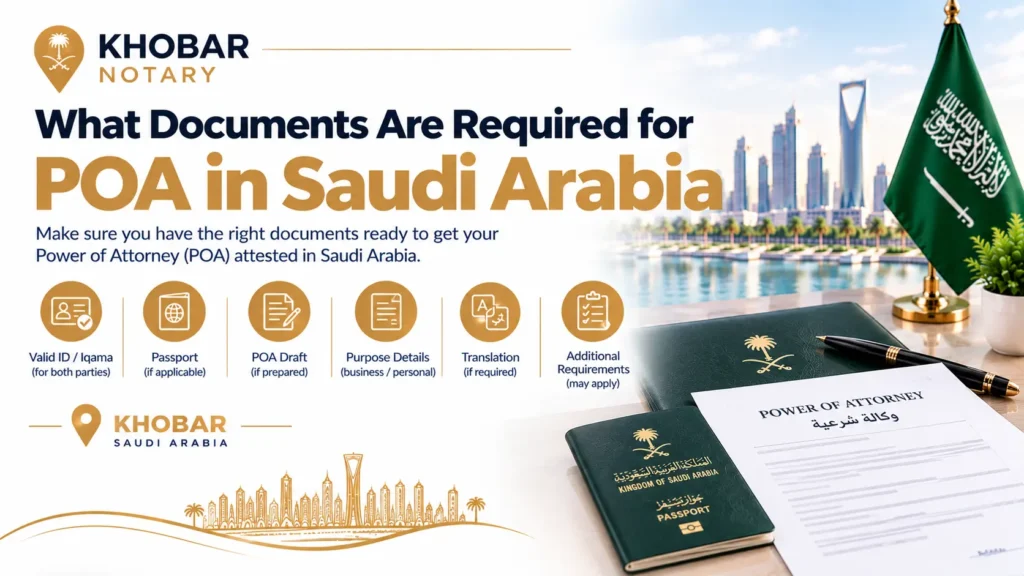
If you’re about to issue a Power of Attorney (POA) in Saudi Arabia, you’re probably wondering exactly what you’ll need to have ready. The good news is that for most individual POAs, the requirements are straightforward especially now that much of the process can be completed electronically through Najiz.
This guide walks through exactly what documents and information are required, based on the Ministry of Justice’s current electronic POA service.
Last updated: November 2026, based on the Ministry of Justice’s official e-service pages.
What Information Is Actually Needed?
Issuing a Power of Attorney mainly requires identity information for both the principal (the person granting the power) and the agent (the person receiving it), along with clear details of what the POA will cover. For documents issued electronically through Najiz, you typically won’t need physical paperwork at all the system verifies everything digitally.
Who Needs This Information Ready?
This applies to:
- Individuals issuing a POA for personal, financial, or property matters
- Business owners authorizing someone to act for the company
- Families arranging a multi-party POA involving several principals
- Anyone handling a POA that was issued outside Saudi Arabia and needs to be used within the Kingdom
Documents and Information Required
For Electronic (Najiz) POA Issuance
To issue an individual POA electronically through Najiz, you’ll generally need:
- National ID or Iqama number, for both the principal and the agent (or agents)
- Date of birth, for both parties
- An active Absher account, since Najiz login requires National Single Sign-On (النفاذ الوطني الموحد) credentials
- A valid, unexpired ID, as an expired ID limits what type of POA can be issued electronically
No physical documents or office visit are required for a standard individual e-POA everything is entered and verified digitally.
For a Multi-Party POA
If more than one principal is involved, Najiz additionally requires:
- Identity and verification details for each principal involved (POAs can include between 2 and 50 principals)
- Confirmation from every listed principal within 48 hours of submission anyone who doesn’t confirm in time is excluded from the final issued POA
The Ministry of Justice also notes that Saudi principals must appoint Saudi agents, while resident principals may appoint either Saudi nationals or residents.
For a POA Issued Outside Saudi Arabia
If the POA was issued abroad and needs to be used in Saudi Arabia, it must first be authenticated in the country where it was issued — with an Apostille if that country is an Apostille member (Saudi Arabia joined on 7 December 2022), or through Saudi Embassy legalization and Ministry of Foreign Affairs attestation if it is not. It is then submitted through Najiz (for example via the Virtual Notary Public service) so the Ministry of Justice can approve it before it becomes valid for use with Saudi government entities, banks, and companies.
When a Notary Visit Is Still Required
Not every situation qualifies for fully electronic issuance. A visit to a notary (or the “virtual notary” option) is typically needed when:
- The principal is over 65 years old and has never issued a POA before — the first one must go through the Virtual Notary Public or a private notary; later ones can be issued electronically
- The principal’s ID has expired in this case, Najiz only allows issuing a limited POA for claims and court matters electronically; other types require a notary
- The required POA type or clause isn’t available through direct electronic issuance
Eligibility Requirements to Keep in Mind
Beyond the documents themselves, a few eligibility conditions apply:
- The applicant must be at least 18 years old
- The principal must not be legally barred from granting a POA, such as by a court ruling or guardianship decree
- For POAs involving court cases or legal claims, the agent must either be a licensed lawyer or a relative up to the fourth degree
Important Things to Know
- An electronic POA issued through Najiz is valid for a maximum of one year; if you need a different duration, confirm the options with a notary for your specific situation.
- A POA issued electronically through Najiz is officially recognized by government entities, banks, and companies without needing a physical stamp.
- Requirements can be updated by the Ministry of Justice, so it’s worth confirming current details through Najiz directly before starting.
Need Help With Your Power of Attorney?
If you’re unsure which documents apply to your situation, or you’re dealing with a POA issued outside Saudi Arabia, Khobar Notary can guide you through the requirements and help you complete the process correctly. Contact us today to discuss your specific case.
Conclusion
For most individual POAs, the document requirements are simple: valid ID information for both parties and an active Absher account. More complex situations multi-party POAs, expired IDs, or foreign-issued documents involve a few extra steps, but nothing that can’t be handled with the right guidance.
Frequently Asked Questions
1. How do I get a power of attorney in Saudi Arabia?
You can issue a POA by logging into Najiz with your Absher (National Single Sign-On) credentials, selecting “Powers of Attorney and Declarations,” choosing “Issue a Power of Attorney,” and entering the required ID details for both the principal and agent. Certain cases, like an expired ID or a first-time POA for someone over 65, require visiting a notary instead.
2. What is the quickest way to get a power of attorney?
Issuing an individual POA electronically through Najiz is generally the fastest option, since it can be completed in minutes without visiting a notary’s office, provided you have an active Absher account and valid ID.
3. What is the easiest way to do a power of attorney?
For most people, the Najiz electronic service is the easiest route you enter the principal’s and agent’s ID details, select the type of POA and its terms, and submit the request online without paperwork or an office visit.
4. How do I get a document notarized in Saudi Arabia?
Many documents can be notarized electronically through Najiz, while others require visiting a notary (كاتب عدل) in person or through the virtual notary option, depending on the document type and whether all eligibility conditions for electronic processing are met.
5. What documents are required for Power of Attorney in Saudi Arabia?
You’ll typically need the National ID or Iqama number and date of birth for both the principal and agent, along with an active Absher account. Multi-party POAs, expired IDs, or foreign-issued POAs involve additional requirements.